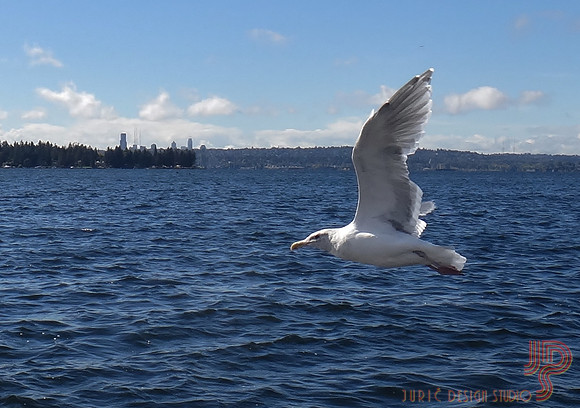
Catching birds in flight is considered as one of the hard and expensive focuses in photography. High quality long lenses are usually the most expensive and heaviest lenses around. Cameras with super fast focus, capable of tracking fast moving birds in flight are usually in the group of most expensive and heaviest cameras. Lugging this heavy equipment through wilderness and exposing it to the weather is not easy either.
On the other end of the spectrum are people like me who like to shoot at the occasional flying bird even if the only camera I got today during lunch was my small pocket camera sporting short and cheap lens, with focus that takes a while to find its target.
So how are we to take any half decent flying pooper photos?
By cheating, of course!
- Find the bird that landed close to you.
- Look for the good, clutter free background for your photo, and circle the bird so that good background is on the other side of the bird.
- Set your camera to sunny weather (do not try this on overcast or dark day, because you'll need all the light you can get to make it sharp).
- Another important setting is a 'sport' scene or other settings where the shutter speed is favored on the expense of the aperture and ISO. Even lazy birds are moving fairly fast, and you want a sharp photo here.
- Set your camera to the continuous shooting, so you can press the button once and the camera will continue snapping pictures until the memory is full or you do not see the bird anymore.
- Come slowly toward the bird. Do not scare it away. Eventually, the bird will decide you are close enough and fly away, but every step you can make toward it, will be toward a better photo. Keep the bird framed in the camera ready to shoot at any moment. Adjust the zoom as you are coming closer to have plenty of space around it. You'll need this space later for cropping and in a few moments to catch the bird, as they move fast.
- As soon as the bird gets ready for flying - stop walking, aim the camera better and start shooting. If you do it nice and steady, following the bird with the camera but not with your body, pictures will have a good chance of showing you all details of the flying bird. Try catching it while it is still low, as those are better looking shots than bottom of the bird. We all see bottoms as they fly over us, but a side shot or from the top (when taking pics from a tall building), are less common and more interesting.
- If bird didn't fly too far, you may be able to repeat the procedure. Optionally, you may want to send somebody to annoy the bird from the other side, so it would fly toward you, but try to avoid having a chaser in the picture unless it is your own kid.
- Once you upload all BIF photos to your computer, delete all fuzzy shots, and look through whatever is left. Chose only one or two final photos as the best and crop them to look good. Rule of thirds is good to use here, and leave a space in front of the bird so it doesn't fly into the edge. It looks better that way.
- Publish the photo so we can all enjoy it.
~~~~~~~~~~
Данас сам опет ручао на молу и овај галеб ми је правио друштво. Надао се да ћу му бацити нешто за јело, или барем испустити неки залогај. Од свега није добио ништа осим слике па ми је сада жао што му нисам платио за услугу. Можда следећи пут. :)